
ABOUT THE BOOK
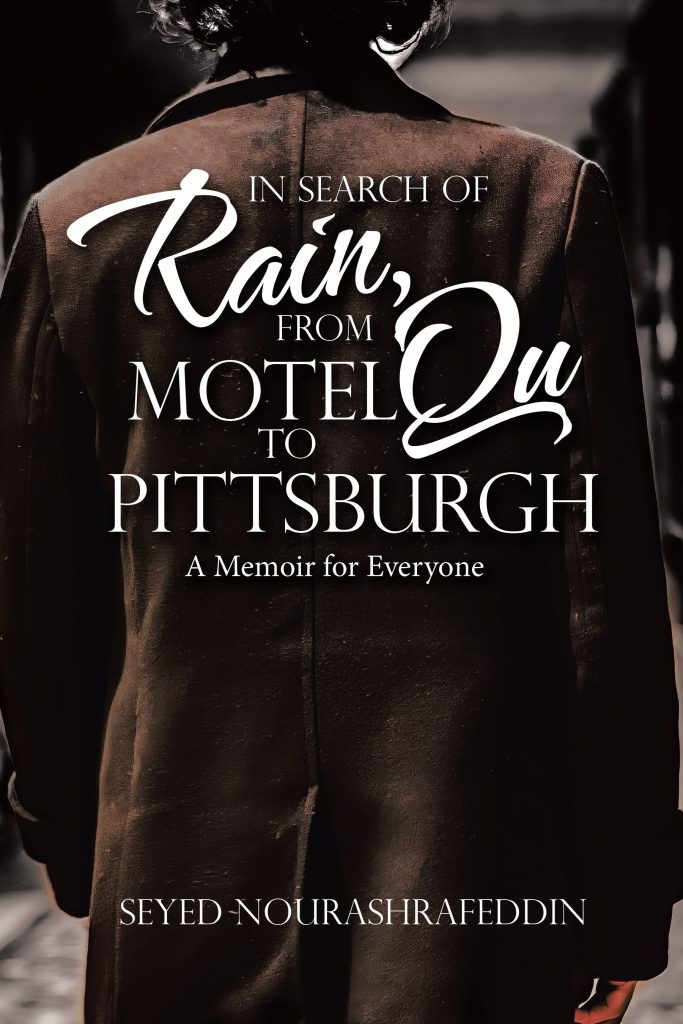
In Search of Rain from Motel Qu to Pittsburgh is a powerful and deeply human memoir chronicling Seyed Nourashrafeddin’s extraordinary journey from the shadows of war and poverty in Iran to academic triumph in the United States.
Raised in a small Iranian town during the turbulence of the Islamic Revolution and the Iran-Iraq War, Seyed’s childhood was marked by hardship: a father battling addiction, the burden of supporting his family from a young age, and the struggle to find purpose amidst chaos. Against all odds, and through moments of despair, grit, and unexpected inspiration, he rises from academic failure to become a respected scholar in molecular medicine.
In Search of Rain not only deals with Seyed’s gradual evolution as a member of so-called the “burnt generation” after the Islamic Republic of Iran, but also points out various cultural and socio-political aspects of his country and even lifestyle, traveling, and immigration.
From the dusty streets of Motel Qu to the labs of Pittsburgh, In Search of Rain is a story of resilience, transformation, and hope. The “rain” in the title symbolizes more than a change in location, it speaks to a yearning for opportunity, peace, and renewal.
Seyed’s story speaks to anyone who has faced overwhelming adversity, dared to dream beyond their circumstances, or fought for a better future. His life is a testament to the human spirit’s ability to endure and rise.
ISBN 13 (SOFT): 9781665767491
ISBN 13 (eBook): 9781665767507
An excerpt of the Book:
During that time, the country had become the arena of social protests. With the intensification of the economic crisis and the spread of poverty among various sections of the society, workers, teachers and retirees formed many union protests, most of which were directed at livelihood problems, but all these protests were suppressed by the security forces. People had been trapped in a cell called “oppression”. Then they poured into the streets with empty hands and chanted “Neither Gaza nor Lebanon, I sacrifice myself for Iran”. The employees had no money and the shopkeepers were in a lot of debt. But the parliament was involved in hijab and the Internet and determining the names of children! Day by day, new laws were enacted to the detriment of the people, but the laws that benefited the people gradually became obsolete. In Iran, categories such as human right, dignity, freedom and justice had no value at all. In Iran, people were losing their lives like fallen leaves due to the carelessness and incompetence of the authorities, from fires and plane crashes to deaths due to car accidents. In Iran, freedom was a clichéd category, justice was a word that could be only found in books and had become a wish for people. In each election period, a more hypocritical government than the previous one came to power and painted a dark color on the door and walls of this big prison and trumpeted the concepts of freedom, human rights and their religious democracy to show it to the western countries.
Besides studying, I was interested in politics, but I was never a political person. Once upon time, I wanted to get into the parliament as a representative of the people of my city and serve my beloved people. But later I realized that representing the parliament is not compatible with my spirit and achieving dreams is not always achieved with effort. Sometimes you need to be like a group that you have no harmony with! I was disappointed with the conditions of my country and the fate of its people. Everything in the world of politics was mixed with hypocrisy and stank, and in this black night, I was looking for a thread and a needle to patch my torn socks. We couldn’t do anything except regretting and fruitless protests. It was as if we were standing in front of the mirror and cursing ourselves. The world of politics was too dirty for us to do anything about. Iran was in the hands of the Mullahs. All of them were deceiving people and betraying them. Some of them said that you deserve whatever trouble happens to you! You shouldn’t have made a revolution! It was the era of the Mullahs. The Supreme Mullah considered himself the vicegerent of God on earth and was not answerable to anyone. He considered himself the owner of the lives and property of the people. He tried to choose the officials of the country’s executive powers and government organizations from among the Mullahs so that they would not impeach him.
In those years, the officials were constantly changing especially after the election of a new president. With the change of each presidency, a wave of managerial changes was formed in all departments and organizations. All officials appointed their family members, friends and individuals with similar ideologies to the managerial positions. It was often seen that people who came to power took personal and political revenge on previous ones. New bosses and officials destroyed the previous ones or put them in prison so that they could promote themselves. Iran was suffering from a syndrome called “extremists’ syndrome,” and a lot of energy, time and money was spent on political disputes. The main question was whether changing officials was enough to improve the situation in the country or whether the structure and rules should be changed…
This excerpt is published here courtesy of the author and should not be reprinted without permission.